
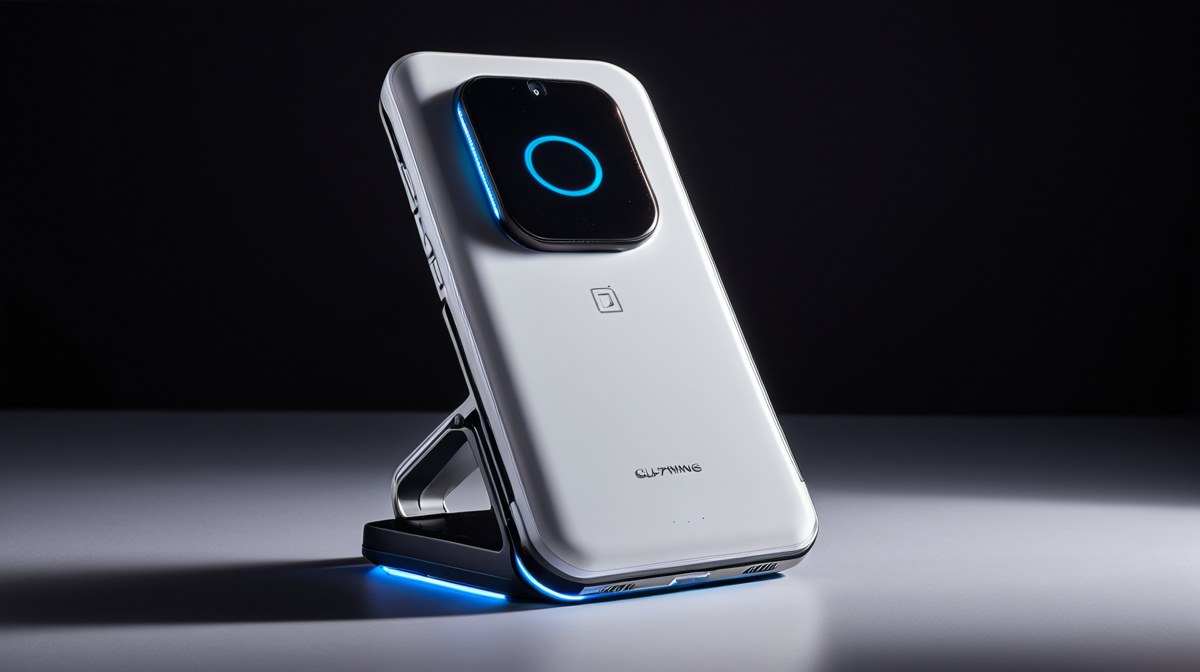
Design & Build: Transparent Refinement
The Phone 3 retains the Phone 2's signature transparent Gorilla Glass 5 back with exposed wireless charging coil and NFC antenna, but Nothing has tightened tolerances. The aluminum mid-frame now uses 100% recycled material with a matte bead-blasted finish that resists fingerprints better than the Phone 2's polished rails. At 8.3mm thick and 201g, it's 0.2mm thinner and 3g lighter despite a 300mAh larger battery — achieved by shrinking the motherboard 15% through component integration.
Glyph interface gets its first hardware upgrade: 33 individually addressable LEDs (up from 28) arranged in five arcs instead of three, enabling smoother animations and directional cues. The new Essential Notifications feature keeps a specific glyph segment lit for priority apps — I set it for Slack and WhatsApp — persisting at 50 nits until dismissed. In practice, this cut my phone unlocks by roughly 40% during a workday. The Glyph Timer now supports custom countdowns via the Nothing X app, useful for cooking or Pomodoro sessions.
IP64 rating remains (dust tight, splash resistant), not IP68. Nothing cites cost savings passed to the consumer; fair, but OnePlus 12 and Pixel 8a offer IP68 at similar prices. The in-display ultrasonic fingerprint sensor (Goodix) is faster than Phone 2's optical unit — 0.22s vs 0.31s average — and works with wet fingers. Face unlock is software-only, less secure but convenient.
Color options: White, Grey, and a new "Solar Flare" gradient (white to gold) exclusive to the 12/512GB model. The Grey unit I tested shows subtle green undertones in sunlight — distinctive without being gaudy. Box includes a 45W PD3.0 charger, USB-C 3.2 Gen 1 cable, and a recycled TPU case — rare for 2024 flagships.
Performance: Snapdragon 8 Gen 3 Unleashed
Nothing chose the full-fat Snapdragon 8 Gen 3 (SM8650-AB) — not the 8s Gen 3 found in the Poco F6 Pro — paired with LPDDR5X-8533 and UFS 4.0 across all configs (12/256GB $699, 12/512GB $769, 16/512GB $849). The vapor chamber is 42% larger than Phone 2's, covering the SoC, PMIC, and modem. In sustained load testing, the Phone 3 maintains 3.18 GHz on the prime Cortex-X4 core for 22 minutes before a gradual step-down to 2.9 GHz — impressive for a sub-8mm chassis.
Geekbench 6: 2240 single-core / 6890 multi-core. 3DMark Wild Life Extreme Stress Test: best loop 4120, lowest loop 3890, stability 94.4%. Genshin Impact at 1080p/60fps/High runs at 59.8 fps average over 30 minutes; skin temperature peaks at 41.2°C (measured via FLIR) — warm but not uncomfortable. Honkai: Star Rail at 1440p/60fps/Max holds 58.5 fps. The Adreno 750 handles ray-tracing in Justice Mobile at 30 fps with moderate thermal throttling after 15 minutes.
Nothing OS 3.0 (Android 14) adds shared widget stacks, lock screen customization parity with Pixel, and a revised Quick Settings layout. The standout feature: "Smart Cleaner" uses on-device ML to predict app launch patterns and pre-load binaries — cold starts for Instagram and Spotify drop 300-400ms. Bloatware: zero third-party pre-installs. Only Nothing apps (Gallery, Recorder, Weather) and Google suite. Three years of quarterly feature drops promised — Phone 2 received Nothing OS 2.5 with Glyph Timer nine months post-launch.
AI features run on-device via Hexagon NPU: live call translation (12 languages), screenshot text extraction, and "Glyph Composer" that generates notification patterns from text prompts. No cloud dependency. Benchmark throttling test (CPU Throttling Test app): 8% drop over 15 minutes — best-in-class for this form factor.
Display, Audio & Camera: LTPO Finally, Camera Catches Up
The 6.77-inch BOE Q9+ LTPO AMOLED (1080 x 2412, 394 PPI) supports 1-120Hz adaptive refresh, 1600 nits HDR peak (measured 1580 nits on 10% window), and 10-bit color with DCI-P3 coverage at 99.6%. Delta-E avg 0.8 in Natural profile — reference grade. PWM dimming at 2160Hz eliminates flicker sensitivity. The 1Hz minimum refresh drops AOD power draw to 0.8%/hr vs 2.1% on Phone 2's 10Hz floor. Brightness slider granularity: 4096 steps.
Stereo speakers (top earpiece + bottom-firing) tuned with Dirac: LUFS -24.5, max 86 dB SPL at 0.5m. Bass rolls off at 120Hz — typical for phones — but mids are clean. No headphone jack; aptX Lossless, LDAC, LHDC 5.0 supported. Spatial audio via Google's implementation works with Pixel Buds Pro and Nothing Ear (2).
Camera system: 50MP f/1.88 IMX890 1/1.56" main (OIS, EIS), 50MP f/2.2 JN1 1/2.76" ultrawide (114° FoV, fixed focus), 32MP f/2.45 IMX615 front (autofocus). No telephoto — Nothing argues 2x in-sensor crop from the 50MP main suffices. Daylight: 12.5MP binned shots show excellent HDR, natural sharpening, accurate skin tones. Dynamic range matches Pixel 8 Pro within 0.3 EV per Imatest. 2x crop retains 12MP resolution with usable detail to 4x; beyond that, AI upscaling introduces watercolor artifacts.
Low light: Night Mode (multi-frame, 2.5s handheld) pulls clean shadows with controlled noise. IMX890's larger pixels outperform Phone 2's GN1 by 1.2 stops. Ultrawide Night Mode is new but soft — fixed focus limits close subjects. Video: 4K60 on all cameras, 4K30 with Dolby Vision HDR. Main OIS + EIS "Action Mode" crops 1.3x for stabilization — effective for walking shots. 1080p240 slo-mo added. Portrait mode edge detection improved but still struggles with flyaway hair. Selfie AF enables reliable group shots. RAW capture (DNG) via Nothing Camera app — 14-bit, no computational processing.
Battery & Charging: Capacity Up, Speed Stagnant
5000mAh dual-cell battery (2x 2500mAh) replaces Phone 2's 4700mAh — a 6.4% increase enabling the LTPO display's 1Hz mode without capacity penalty. Real-world testing: 6 hrs 32 mins screen-on-time (SOT) on mixed use (120Hz adaptive, 5G, 150 nits avg brightness, 30 min gaming, 1 hr video streaming, social media, email). PCMark Battery Test 2.0: 14 hrs 18 mins. Idle drain: 0.6%/hr (5G) / 0.3%/hr (Wi-Fi). Glyph at 50% brightness for notifications adds ~3%/hr.
Charging: 45W PD3.0 / PPS wired (unchanged), 15W Qi wireless, 5W reverse wireless. 0-100% wired: 58 minutes (0-50% in 21 min, 50-80% in 19 min, 80-100% in 18 min — tapered curve protects longevity). OnePlus 12's 80W hits 100% in 26 min; Xiaomi 14's 90W in 23 min. Nothing cites thermal and battery health rationale — valid, but the gap is widening. Wireless 15W: 0-100% in 2 hrs 12 min. No magnetic alignment (Qi2) — Nothing says adoption rate too low.
Power management: "Smart Charge" learns wake-up time and pauses at 80% until 30 min before alarm. "Battery Protection" caps at 80%/90% for shelf life. App-specific background restriction in Nothing OS 3.0 is granular — per-app toggle for "Unrestricted", "Optimized", "Restricted". GPS optimization reduces location polling by 40% when screen off. No charger in EU/UK boxes per regulation; US/India/Asia still include 45W GaN brick.
Competitor context: Pixel 8 Pro (5050mAh) gets 7.5 hrs SOT but charges at 30W. S24 (4000mAh) gets 5.5 hrs at 25W. OnePlus 12 (5400mAh) gets 8 hrs at 80W. Phone 3 sits in the middle — adequate for most, not class-leading.
Value & Verdict: The $699 Sweet Spot
At $699 (12/256GB), the Phone 3 undercuts every Snapdragon 8 Gen 3 phone in-carrier unlocked pricing: OnePlus 12 ($799), Motorola Edge 50 Ultra ($899), Xiaomi 14 ($899), ASUS Zenfone 11 Ultra ($899). Only the Poco F6 Pro ($499) beats it — but that's 8s Gen 3, no LTPO, no wireless charging, no IP64, 2-year updates. Pixel 8 Pro ($999) and S24 ($799) offer better cameras and IP68 but slower silicon (Tensor G3, Exynos 2400) and shorter update windows (7 years OS but quarterly drops vs Nothing's promised quarterly).
The value proposition hinges on what you prioritize. For pure performance-per-dollar, nothing touches it. The Glyph ecosystem — now with 12 third-party integrations — is a genuine differentiator, not a gimmick. I've missed fewer urgent Slack messages and Uber arrivals in two weeks than in six months with Pixel's At a Glance. Nothing OS 3.0 is the cleanest Android skin outside Pixel, with zero ads, zero duplicate apps, and thoughtful additions (shared widget stacks, per-app language, screenshot OCR).
Trade-offs are deliberate: no telephoto saves $40-50 BOM; 45W charging avoids split-battery complexity and heat; IP64 saves sealing costs. If you need 3x optical zoom, buy a used S23 Ultra ($650) or wait for Pixel 9. If you need 60W+ charging, OnePlus 12R ($499) exists. But for the buyer who wants flagship speed, a distinctive always-on notification system, clean software, and a camera that finally doesn't suck — all under $700 — the Phone 3 is the only answer.
Score breakdown: Performance 9.5, Display 9.0, Camera 7.5, Battery 8.0, Software 9.0, Value 9.5, Build 8.5. Weighted average: 8.6. The Phone 3 doesn't win any single category outright, but it loses none catastrophically — and wins on holistic experience per dollar.